Most business owners don’t come to us worried about their clients going quiet. They come to us because they need new leads.
Usually it’s when referrals start drying up, and they become afraid that a slow quarter is actually a bigger indicator of the business itself slowing down. At that point, owners tend to prioritize generating new leads, and keeping leads warm stays low on the totem pole.
Before you chase new leads, look at the email list you already have. Using email marketing to build client relationships with the people already on it is the easiest place to find your next sale.
Is an email newsletter worth it? Yes, for keeping the clients you already have
What owners tend to believe is that newsletters are most important for drawing in new clients. Yes, this is true. A newsletter (when leveraged right) can be a key cog in your content machine. However, it’s much harder to draw in new clients with a newsletter than to retain existing clients and increase customer lifetime value.
With existing clients, you’re constantly staying in front of them, reminding them of the great things you’ve done in the past, and keeping them in your ecosystem so they always know to reference you as their go-to authority.
Your email marketing won’t work overnight, but it’s a long-term strategy that allows you to retain clients, keep leads warm, and stay top of mind. And unlike social media followers, who are purely owned by the platform, your email list belongs to you. You can export it and bring it with you to any newsletter software.

Case study: one newsletter, one blue suit, one same-day sale
We have a retail client, Eastern Clothing, who creates their monthly newsletter with us. Their primary audience is men who need a tailor or who have had something tailored by Eastern Clothing before.
In their latest newsletter, we wrote about the owner, John Airasian, and the fact that he always wears a navy blue suit. It’s such a staple that he recommends it to every man. The same day that newsletter went out, a gentleman read it and came into the store looking for his own navy blue suit.
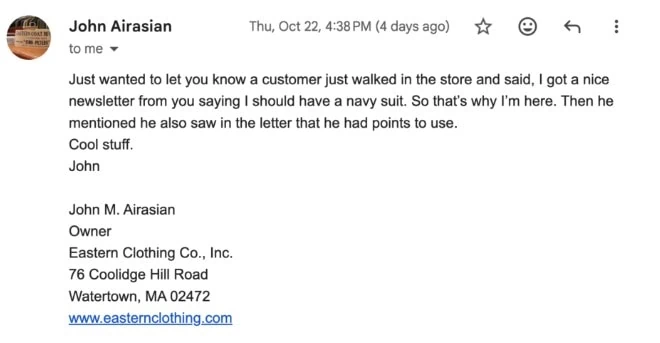
Eastern Clothing is a retail store in Watertown, Massachusetts, not an online retailer.
Somebody saw enough value in that newsletter to literally get in their car, go to the store, and spend their money. That is the power of a newsletter. It can bring cold leads and cold clients back into your store.
And it isn’t a one-off. Eastern Clothing’s 2026 newsletters average a 46.9% open rate and a 4.8% click rate, and across our clients, we’ve traced referrals and returning clients back to emails we wrote.
Worried you have nothing to say, or that you’re repeating yourself?
Business owners often tell us they don’t send a frequent newsletter because they have nothing to say or feel like they’re being repetitive. But it’s repetitive to you because you’re the one creating the content. Not every person on your list is going to open every email, and for the sake of brand consistency and clarity, you need to repeat the same message multiple times before it truly sinks in.
What to send your clients, and how often
Start with a welcome email that helps with client onboarding and gets new clients familiar with your website, your services, and what you’re able to provide for them. You can send it once they’ve started working with you, or during the prospecting stage while they’re still deciding whether you’re a good fit.
After that, a monthly newsletter is a good place to start, and once or twice a month is a good amount of total emails. Sending every day takes a lot of resources and can lead to reader fatigue. Keep each email pretty short, too, since people rarely spend more than 4 or 5 minutes reading one. Still, we wouldn’t worry about sending too much, because that can be easily fixed. We’d worry about sending too little and disappearing completely from a potential client’s inbox. (More on timing in our email marketing FAQ.)
Then adjust based on your own numbers, not industry benchmarks. List size, marketing budget, paid ads and long-form content all change what “good” looks like, even for two businesses in the same industry. Double down on what’s working, and test different ways to improve what’s falling short.

Should you send one newsletter or segment your list?
One of the most common mistakes we see in business emails is trying to talk to everybody at the same time. When you speak to everybody, you speak to no one. Most businesses also grow one master list without realizing different audiences need different content.
Whether to segment really depends on the industry. A bookkeeping business, for example, might have a CPA audience, a potential-client audience and a current-client audience, and they all need different things. But if you’re starting a brand-new newsletter, don’t split your attention. Create one really good newsletter that’s helpful for everybody, and segment later.
One list doesn’t have to mean a generic voice, though. Eastern Clothing sends one monthly newsletter to all of their contacts, and every email speaks to one man who needs a tailor.
Give value before you ask for anything
Most business owners have tried sending emails before they talk to us. Usually their newsletters fall flat because they’re asking things of the client instead of giving away information and sharing instant value before anybody buys anything.
Every newsletter should have one main call to action, and it should be value-driven: a guide, a resource, real information. Then add a standard “book a call” CTA somewhere as a backup, just in case somebody wants to press that button.
What our own two newsletters taught us
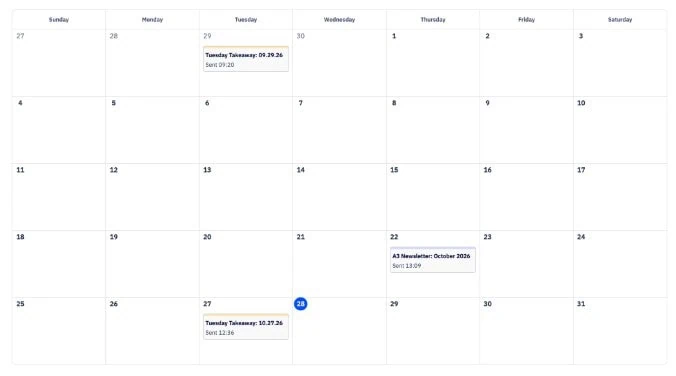
We send two emails of our own: a monthly A3 Newsletter that leads with a free resource, and a biweekly letter called the Tuesday Takeaway, which is read mostly by current clients and usually offers a marketing tip or social platform update. Once, we used the Takeaway to ask readers to fill out a survey. One person did. We compared 16 Newsletters and 30 Tuesday Takeaways sent from September 2025 to October 2026:
| A3 Newsletter | Tuesday Takeaway | |
| What’s inside | Bulletin-style newsletter with the latest A3 blog, a video short by Tara (owner of A3), and a reflection from a team member. | One idea in storytelling format, meant to teach something valuable or bust a marketing myth our clients believe. |
People opened both at about the same rate, but Newsletter readers were twice as likely to click. Emails with a free resource drive nearly 80% higher click rates than our account average. A thoughtful letter with nothing to act on gets read and ignored. (For subject lines, CTAs and design, see 7 Tips to Write an Email Newsletter People Will Actually Open.)
Expect your list to change, and don’t fear unsubscribes
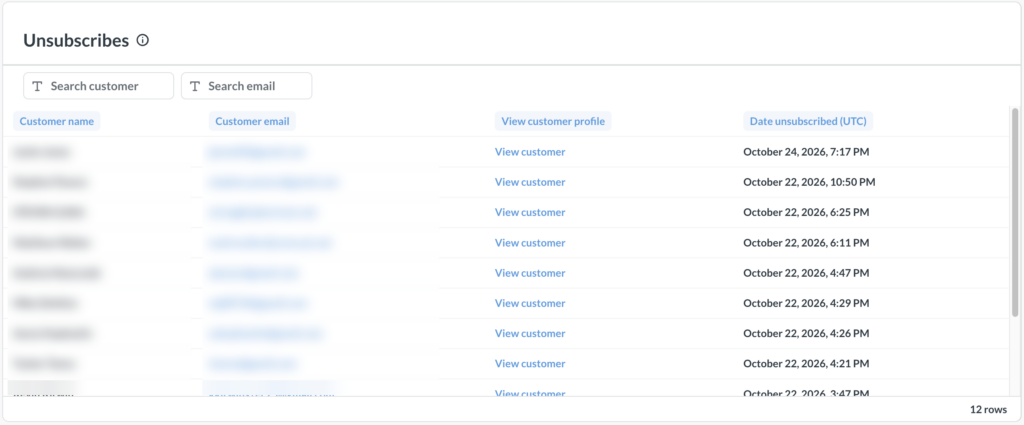
Your newsletter list will fluctuate. Some people will unsubscribe. Others will quietly stick around for a very long time until they get an email that really speaks to them as a person, slowly building trust in your services without you even noticing. It’s the yin and yang of it all, and you can’t have one without the other.
Unsubscribes mean the people who are not meant for you are walking out the door, and that is perfectly fine. The people who are left actually want to listen and be part of your ecosystem. Only an extremely high unsubscribe rate is worth worrying about, because that speaks more to reader fatigue.
For people who never open, we wouldn’t remove them. We’d try a different approach that may re-engage them. Shorter, punchier subject lines really help, and even an emoji helps a subject line stand out in the inbox.
When an email newsletter isn’t the right fit
If you’re a once-and-done kind of business without repeat customers, a newsletter won’t be very effective, because your clients won’t have a reason to keep in touch with you after you deliver your service.
A newsletter also can’t do the work on its own. Growing a newsletter without a presence anywhere else is difficult and resource-intensive. People find you through social media, your blog and search, and then end up on your contact list. So make sure you’re showing up where people already are before you create a strategy that brings them into your own mailing list.
How we build client relationships with email marketing
Every email engagement starts with an exploratory call. We figure out where you are right now, what has already worked and what isn’t working, so we can double down on what’s working for you.
From there, we put together a proposal that fits your needs. That could be targeted emails to specific audiences, including newsletter setup and audience segmentation. Or it could be a monthly, bulletin-style newsletter that keeps you top of mind and keeps clients informed of important dates and relevant knowledge.
We handle the entire email strategy, setup and writing. We’re not experts in what our clients are experts in. We are experts at drawing that knowledge out and shaping it so a mass audience can relate to it. On your end, that means one hour a month to share your insights, plus approving each newsletter.
Not sure which setup fits your business? Book a 15-minute call, and we’ll build a proposal around it. Email marketing is part of our Pulse Marketing Plan.